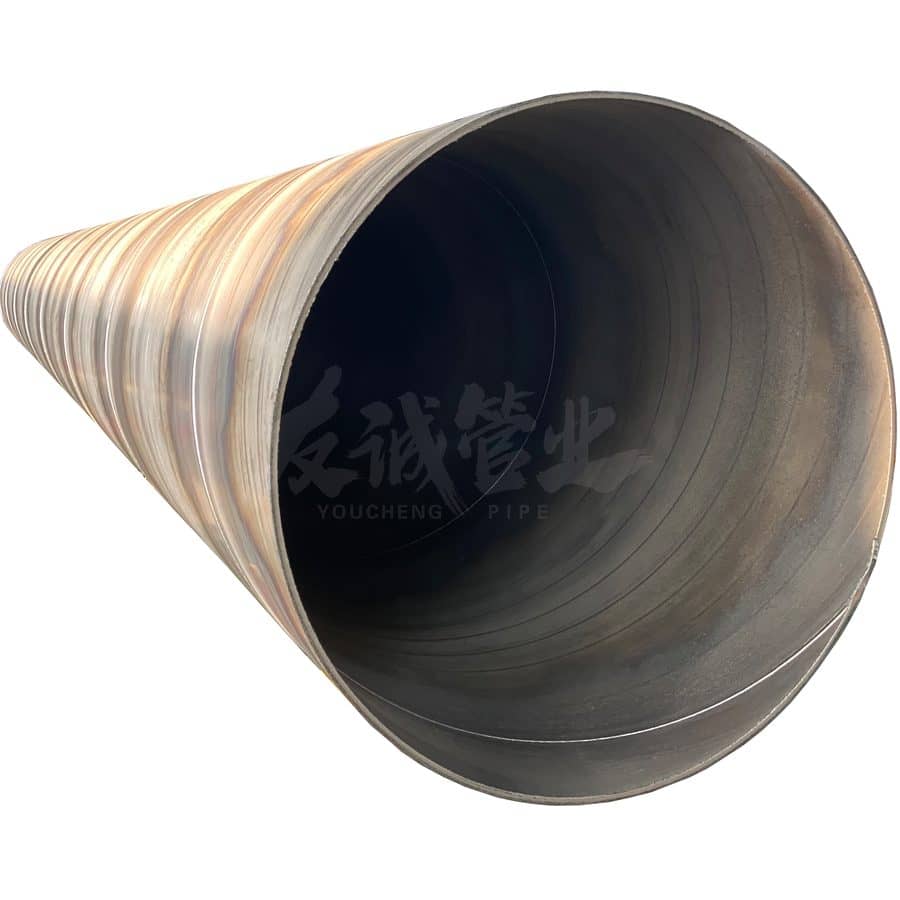
Choosing pipe for a long-distance line starts with diameter, not price. Spiral welded pipe (SSAW) is formed from coil: by changing the helix angle, the same coil width produces different diameters, which is why it wins on cost above roughly DN600. Longitudinal submerged-arc pipe (LSAW) is limited by plate width — the larger the diameter, the harder the plate match and the faster the cost climbs.
Second, wall thickness and steel grade. Double-sided submerged arc spiral welding is stable in heavy wall, and grades such as X70 and X80 can be supplied to standard. LSAW is mature in the heavy-wall, high-grade range but costs more. Design pressure sets the wall thickness; the medium sets the grade. Once these two are fixed, the shortlist is clear.
Third, weld seam length. A spiral seam is longer than a longitudinal seam over the same 12 m of pipe, so there is more NDT work. On the other hand the spiral seam distributes stress more evenly, which suits buried long-distance lines under internal pressure.
Economics come last. Put diameter, wall thickness, steel grade, inspection ratio and transport on one sheet and compare. The usual result: above DN600, at low-to-medium pressure, for water transmission or district heating, spiral welded pipe gives the lower total cost; high pressure, heavy wall, high grade and station piping favour LSAW.
One last caution: state the standard and its edition in the contract. GB/T 9711, SY/T 5037 and GB/T 3091 cover different scopes — name the wrong one and acceptance becomes a problem.
Tell us the medium, diameter and design pressure — our engineers will answer with a specification, not a brochure.